
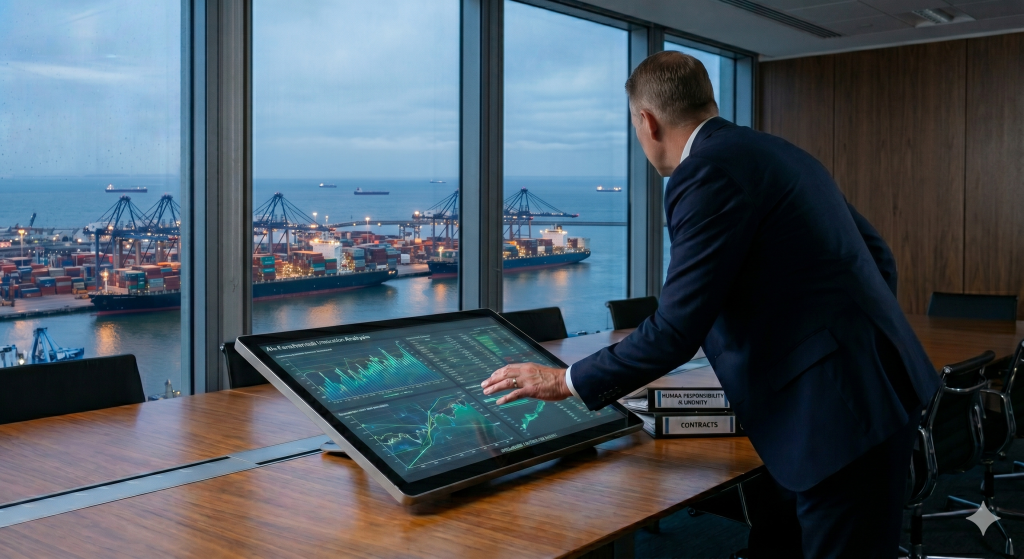
The maritime world is aggressively integrating Artificial Intelligence into our corporate operations—from predictive vessel maintenance, vessel design and automated chartering workflows to complex bunker procurement hedging and managing regular emails. AI offers undeniable advantages as it can process vast datasets without fatigue and perform actions faster than most humans can. However an AI-driven business model runs the risk of inadvertently creating a ‘responsibility vacuum’ where we are not holding the output of these machines to the same professional standards we demand from our human workforce.
In any maritime organisation, there is a clear expectation for human capital: as an employee progresses from a junior analyst to a senior commercial manager, their ‘self-learning’ is expected to yield higher quality output and, crucially, a greater assumption of responsibility. We invest in people because we expect them to eventually own their decisions and deliver returns on the time and money invested in their careers.
By contrast, AI (as we currently know it) does not have a pre-determined career trajectory or a sense of professional indemnity. It is a tool entirely dependent on human-defined parameters. Despite this, there is a growing tendency in the boardroom to grant AI a level of ‘grace’ for errors that would be grounds for dismissal if committed by a human executive.
The most jarring evidence of this double standard lies in the legal frameworks of the technology itself. Consider Microsoft CoPilot, which famously included legacy clauses in its contracts stating that its outputs were for ‘entertainment purposes only’ and should not be relied upon for accuracy. While Microsoft argues that modern iterations have moved beyond this, the existence of such language is a stark admission of the technology’s inherent limitations and the intended abdication of responsibility for the outputs.
Imagine a fleet manager presenting a voyage estimation to a shipowner with the caveat: “This data is primarily for your entertainment; I cannot guarantee its accuracy.” They would be escorted out of the building. Yet, we are increasingly comfortable allowing AI to influence multi-million-pound decisions under similar veils of limited liability. There is no doubt that AI can accelerate output and progress, but maritime must establish a more rigorous framework for technology integration.
We cannot allow the ‘machine’ to dilute the culture of accountability that defines our sector. Just as the captain of a vessel remains ultimately responsible for the ship—irrespective of the sophisticated navigation data provided—maritime business leaders must remain the final arbiters of commercial risk.
Corporate structures must clearly define where the AI’s ‘advice’ ends and human ‘responsibility’ begins so that there is no ambiguity in who owns the fallout of an algorithmic error. Additionally, employees must be explicitly empowered to deviate from AI-generated insights if they carry the liability for a commercial failure – and must not be penalised for ‘inefficiency’. This is a cultural shift that will require investing in the time and training required for staff to audit AI outputs, rather than treating the machine as an infallible authority.
We must remember that AI is an exceptional tool for data processing, but is a poor substitute for professional accountability. If companies are to trust this technology with their balance sheets, we must hold it to the same scrutiny as the people who sign the contracts. Simply put, we cannot automate our risk approach.