
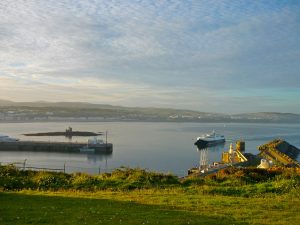
I find that being an entrepreneur is approximately 50% struggle, 40% drudgery and 10% total excitement and joy. Going to the Isle of Man for the first time to speak at the Isle of Man Maritime conference was definitely the latter. To experience a new place, bring an ‘expert view’ and mull over the future of Maritime in such a beautiful context was a pleasure.
The Isle of Man has a unique opportunity to create a point of differentiation regarding the growth of its Maritime industry, due to things like the very close connection between industry and policy/government, its proud naval history, world-recognised brand and the island’s openness to adapting to changes such as the power of AI.
The adoption of AI was a key focus across a number of sessions with a recognition that AI will be critical to increased efficiency, developing new capabilities and skills plus creating new job opportunities. Although, I think that the sheer breadth and depth of change AI is capable of causes it to be viewed, by many people, as this big, abstract, transformational beast that feels difficult to comprehend.
However, I think it can be broken down quite simply as fundamentally, AI is a tool for doing more complex modelling that was not previously possible on a wide scale. In my opinion this can be divided into two categories: firstly, access to tools and services that allow people to work better and secondly the opportunity to leverage AI methodologies to create those new tools and services.
The former can be treated relatively simply, like introducing any other new tool/service into a business. Perhaps start with a needs assessment, capability gap analysis or landscape scoping for new opportunities, identify the best-fit AI solution, undertake a risk assessment, procure the solution and train staff to use this new tool/service. A very simple example might be using ChatGPT to scout for target contacts in a business development context.
The latter is where things become very complex, this is something I can attest to as we’ve spent two years and tens of thousands of pounds developing a new AI-driven solution for port energy optimisation. This required us to properly understand the challenge, engage some incredibly intelligent software developers that specialise in AI and collaborate between practitioners and developers to design a new AI-based methodology, before building it into a usable tool. Whilst this has been a super rewarding process, I doubt it’ll be the avenue that most people go down.
Key implications and considerations for the first scenario would be things like reliability of the selected tool or service, data needs/quality, trust, cyber security risks and staff training requirements to incorporate the solution into day to day operations. Within this bucket there is certainly a range of impact and risk associated with an AI-driven tool. For example, using ChatGPT to identify business development targets might be a relatively low risk exercise versus incorporating an AI-driven scheduling tool into port operations. The consequences of a mistake or something going wrong is relatively little in the first example but could be detrimental in the latter. However, mitigating this risk is once again a fairly straightforward process, for example, incorporating a ‘human in the loop’, where an experienced person checks AI-driven decisions and can override where necessary. This will come down to the risk appetite, mitigation capability and output desire of the adopting organisation. In all cases you should be able to tackle these considerations with the provider of the AI-driven tool/service.
The second scenario, which is developing new AI-driven methodologies to build tools/services that address problems in a highly novel way, will also have implications for places like the Isle of Man. I see these as being wider societal implications such as AI training in schools so that children can learn about the benefits and pitfalls of using this new technology. It may even encourage them to choose a career in software development to leverage the AI boom. Or perhaps it will be the consideration of wider regulatory safeguards needed to protect and control the impact of AI.
Overall, I think there’s no doubt about the power of AI but when you break it down, the adoption of AI can be treated the same as the emergence of any other novel capability, for example, the introduction of Microsoft Excel in the 1980s or the emergence of the internet in the 1990s.
—————–
Words by Arsha Branson, MD Net Zero Hero Photo Credit: Unsplash
———————-
Like this article? Click here to sign up for our free monthly ‘De-Mystifying Digitalisation and AI in Maritime’ newsletter and get the latest cross-sector expert insights, news, interviews, videos and case studies straight to your inbox. You can also buy a ticket to the Demystifying AI in Maritime 2026 London Summit here.